
$460 billion Bitcoin risk draws BlackRock, Coinbase and Strategy into $15M quantum defense mission
By Oluwapelumi Adejumo
Read original article on CryptoSlateBlackRock, Coinbase and Strategy are backing a $15 million effort to prepare Bitcoin against future quantum-computing attacks.
The companies are among nine founding members of the Bitcoin Security Consortium, announced July 23 to support developers and researchers working on the network’s long-term security.
The consortium also includes Anchorage Digital, ARK Invest, Block, Blockstream, Fidelity Digital Assets and Galaxy, bringing together asset managers, custodians, exchanges, infrastructure providers and companies with substantial businesses or holdings tied to Bitcoin.
Quantum computing will be the group’s first focus as advances in the technology draw greater attention to cryptographic systems that could eventually become vulnerable.
Phong Le, Chief Executive Officer of Strategy, said:
“As long-term holders, we have every incentive to see Bitcoin remain secure for generations. Funding the people who do this work, and helping inform the conversation around it, is a natural way for us to contribute.”
Quantum advances raise pressure on Bitcoin’s security timeline
The institutional funding push comes as governments and technology researchers step up preparations for cryptography that can withstand future quantum computers.
Over the past year, researchers, including teams involving Google Quantum AI, have lowered estimates of the computing resources that could eventually be needed to break the type of cryptography Bitcoin uses.
Bitcoin relies on elliptic-curve cryptography to create digital signatures proving that a holder controls the private key required to spend coins.
Conventional computers cannot feasibly reverse that relationship, but a sufficiently powerful quantum computer running Shor’s algorithm could theoretically derive a private key from its corresponding public key.
That creates a potential vulnerability for Bitcoin whose public keys have already been revealed on the blockchain.
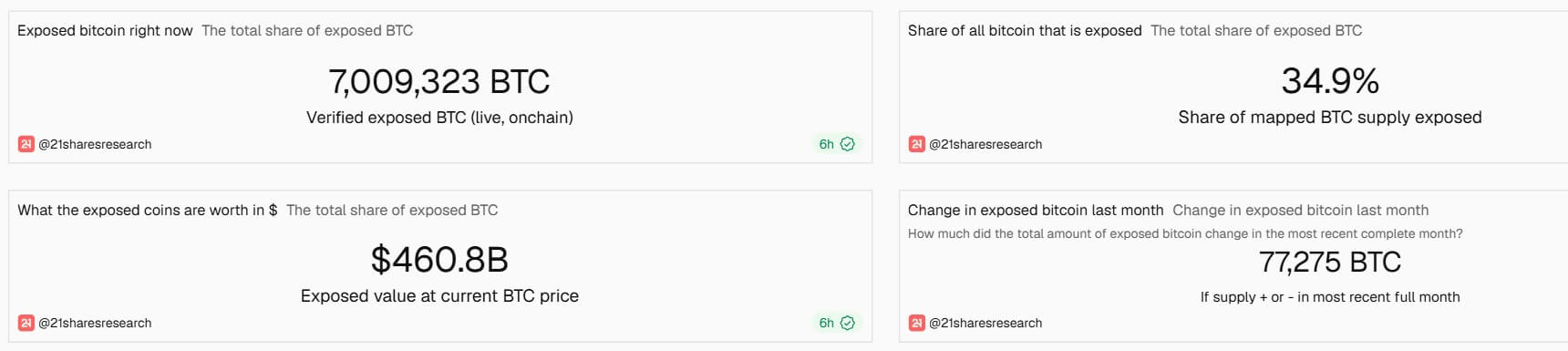
A Dune Analytics dashboard shows more than 7 million BTC in outputs with exposed public keys, representing about 34.9% of the supply covered by its analysis.
Those holdings were worth roughly $460.8 billion at recent prices, while the amount classified as exposed increased by about 77,275 BTC during the most recent complete month.
Those coins cannot be stolen through quantum attacks today because no cryptographically relevant quantum computer capable of breaking Bitcoin’s signatures is known to exist. The concern is how long the network would need to prepare if advances continue reducing the resources required for such an attack.
Capriole Investments founder Charles Edwards has pointed to that uncertainty, recently saying his proprietary “quantum discount factor” for Bitcoin had reached 30% and describing quantum computing as the network’s largest long-term technical threat.
The combination of growing exposed supply and lower estimates for a future attack helps explain why Bitcoin-linked institutions are funding research years before such machines are expected to become viable.
Any move to quantum-resistant signatures would require developers to design, review and test new cryptography before wallets, exchanges, miners, node operators and users could adopt it across the network.
For BlackRock, Coinbase, Strategy and the consortium’s other members, funding that work now gives developers more time to prepare while the threat remains theoretical.
Corporate funding cannot resolve Bitcoin’s quantum dilemma
The consortium’s structure is designed to limit corporate influence, but those safeguards also show how little control its members have over Bitcoin’s eventual quantum defense.
Putting millions of dollars from some of Bitcoin’s largest corporate stakeholders behind open-source development raises an immediate governance question: how to support the network without allowing financial backers to steer its technical direction.
The consortium appointed Mike Schmidt, executive director of Bitcoin developer funding nonprofit Brink, to coordinate its day-to-day work on a volunteer basis.
Schmidt said he spoke individually with each member before accepting the role, seeking assurances that the initiative would remain compatible with Bitcoin’s decentralized development model.
To ensure this, the group has adopted two main safeguards.
It will not pool members’ funding or select grant recipients. Each company will independently decide which developers, researchers and organizations receive its money.
The consortium will also take no official position on changes to Bitcoin’s protocol. Members can express their own views, but the group will neither develop the protocol nor direct the contributors maintaining it.
Those restrictions allow BlackRock, Coinbase and Strategy and the other members to put more resources behind quantum research without deciding which solution Bitcoin ultimately adopts.
That distinction becomes more important as the network moves from identifying the threat to deciding how to address it.
No government, company or developer group can impose a new signature system across Bitcoin. Any major cryptographic change would need to be designed, reviewed and tested before gaining adoption among developers, wallet providers, exchanges, miners, node operators and users.
Galaxy has said the number of developers working specifically on Bitcoin’s quantum resilience remains small relative to the scale of the problem. More funding could expand that pool, but it cannot eliminate the technical and governance trade-offs surrounding a migration.

One of the hardest questions is what should happen to Bitcoin that remains protected by older signatures after quantum-resistant alternatives become available.
BIP-361, a draft proposal co-authored by Casa co-founder Jameson Lopp and other developers, outlines a phased migration away from ECDSA and Schnorr signatures.
The proposal would first prevent users from sending additional BTC to outputs considered vulnerable to quantum attacks.
Later stages would tighten the rules around spending legacy coins while introducing proposed rescue mechanisms intended to distinguish legitimate owners from attackers who had derived private keys using quantum computers.
One possible approach could allow owners of deterministic wallets to prove knowledge of information derived from their original wallet seed that a quantum attacker would not possess. Researchers have also discussed zero-knowledge and commit-reveal methods for recovering affected coins.
Those approaches may not cover every type of Bitcoin output.
The BIP-361 authors say some older pay-to-public-key outputs do not provide the same apparent advantage to legitimate owners, leaving unresolved questions over how those coins could remain spendable without also remaining vulnerable to a future quantum attacker. The proposal discusses compatibility with a separate approach known as Hourglass for some of those holdings.
That leaves developers facing a difficult trade-off.
Keeping legacy signatures usable indefinitely could eventually expose some coins to quantum theft. Restricting them too aggressively could leave legitimate holders unable to spend bitcoin they failed to migrate in time.
BIP-361 remains a draft, and its inclusion in the Bitcoin Improvement Proposal repository does not mean the network has accepted the plan.
The consortium can fund more people to work on those problems and give developers more time to prepare. However, it cannot settle the choices Bitcoin’s users may eventually have to make.
The post $460 billion Bitcoin risk draws BlackRock, Coinbase and Strategy into $15M quantum defense mission appeared first on CryptoSlate.
This story was originally published on CryptoSlate. DennTech aggregates headlines from top crypto publications to keep traders informed.
Read full article on CryptoSlate